We harness fundamental principles of materials science, physics, and chemistry to solve pressing challenges in biology and medicine.
Where Materials Meet the mind
Our laboratory is driven by a multidisciplinary team with combined expertise in materials science, physics, chemistry, and biology. Equipped with fundamental theoretical frameworks and state-of-the-art instrumentation, we pioneer technologies ranging from in vivo optical transparency to deep-tissue light delivery.
Our research
In Vivo Optical Transparency in Living Body
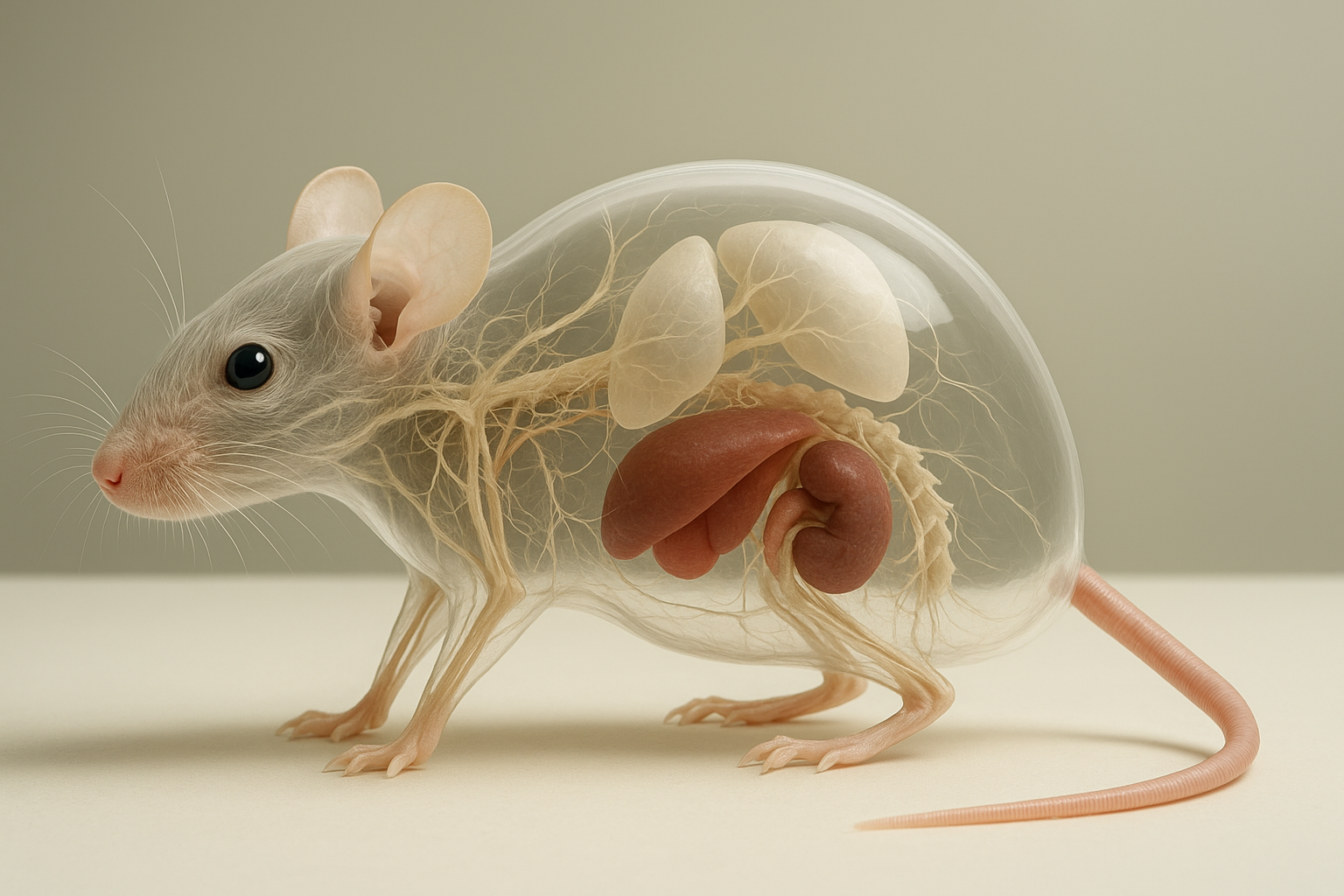
To see is to believe. The inherent opacity of biological tissue limits doctors’ ability to use light for diagnosis and therapy, and similarly restricts biologists from visualizing and manipulating biological activity with optical tools. Our lab has played a leading role in pioneering a new approach to achieving optical transparency in live animals, guided by fundamental photonics principles governing light–tissue interactions. In 2024, we reported the world’s first live ‘transparent mouse.’
An Ultrasound-Scanning In Vivo Light Source
Ultrasound offers deep tissue penetration and the ability to focus in three dimensions throughout the body. Light, by contrast, enables precise interaction with biological systems for modulating activity and treating disease—such as in optogenetics, photodynamic therapy, and photoswitchable gene editing—but is limited by shallow tissue penetration. We leverage mechanoluminescent materials to create an ultrasound-scanning in vivo light source, allowing us to ‘see the sound’ and deliver light anywhere in the body.
Neural Interfaces Based on Near-Infrared Light
Visible light has limited tissue penetration, primarily due to scattering and absorption by tissue components. In contrast, infrared light—particularly wavelengths in the second near-infrared (NIR-II)/short-wave infrared (SWIR) window (1,000–3,000 nm)—penetrates much deeper into tissue owing to substantially reduced scattering. Our lab develops novel infrared-responsive materials that enable minimally invasive neuromodulation using free-space infrared illumination, without the need for any implanted hardware.